Roll the Bones: Why Tawla Night Is the New Screen-Free Hangout in America
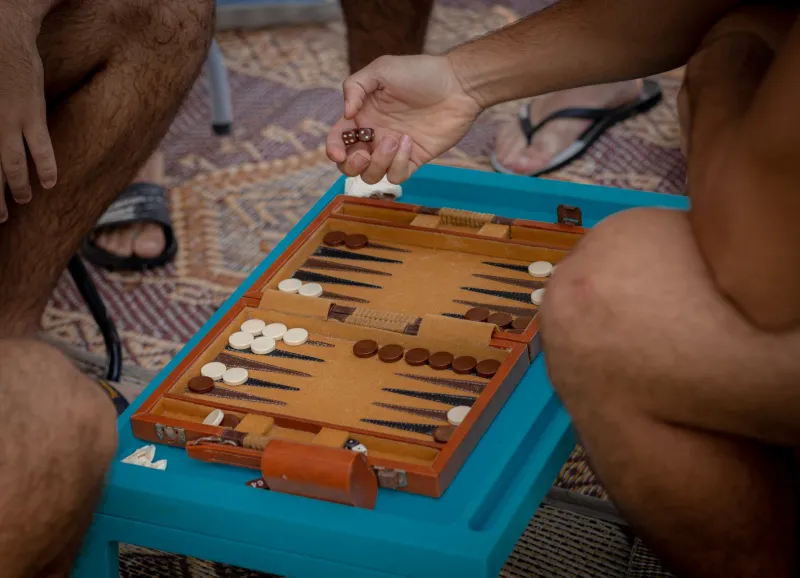
The first thing you notice is the sound. That unmistakable clack-clack-shake of dice in a wooden cup, followed by the satisfying slam of a checker hitting the board. Walk into a handful of cafés in Chicago, Houston, or Queens these days and you'll hear it — tawla, the Middle Eastern incarnation of backgammon, making itself at home in America.
A 5,000-Year-Old App That Never Needed Wi-Fi
Backgammon isn't trendy so much as eternal. The game's ancestors trace back thousands of years to Mesopotamia — which means the dice cups now rattling across Brooklyn tables are cousins of artifacts sitting in the British Museum. Arab communities never let the tradition cool: in Beirut cafés, Damascus courtyards, and Amman teahouses, tawla is background noise for conversation, argument, and three refills of coffee.
So when second-generation Arab-Americans started bringing boards to college dorms and office break rooms, they weren't starting a trend. They were exporting one.
"My dad taught me at the kitchen table when I was eight, same as his dad taught him," says a 29-year-old engineer in Detroit who now hosts a monthly tawla night at a local coffee shop. "My coworkers started as spectators. Now they trash-talk me in a Detroit-Arabic accent. It's beautiful."
The Antidote Nobody Knew They Needed
The timing makes sense. Americans are in a full-blown relationship crisis with their phones, and "screen-free" has become a marketing category. Board game cafés have multiplied. Chess got its streaming era. And backgammon — fast, social, quietly competitive — fits the moment perfectly.
Unlike a four-hour Settlers of Catan commitment, a tawla game takes fifteen minutes. You can talk while you play. You can play while you eat. Losing doesn't require a rules lawyer. It's the rare game that lowers its voice and lets the conversation be the main event — a very Arab café sensibility, and apparently exactly what burnt-out Americans were craving.
Dominoes is riding the same wave, especially in the South and Southwest where it overlaps with existing American traditions. And baloot — the ferociously strategic card game beloved in Saudi Arabia and the Levant — is making appearances wherever there's a foldout table and a long evening.
The Beginner's Guide: Tawla in Five Minutes
Convinced? Here's your starter kit:
The setup: Each player gets 15 checkers arranged on a board of 24 narrow triangles. You'll move your checkers around the board toward your home side based on dice rolls.
The roll: Both players roll one die; the higher number goes first using both dice. Rolling doubles? You get to move four times. Savor it. It won't last.
The goal: Race all your checkers around and off the board before your opponent does. First one out wins.
The twist: Landing on a point occupied by a single opposing checker sends it back to the start. This is called a "hit," and yes, you are allowed to celebrate.
The etiquette: Shake the dice with flair. Complain about your luck loudly and constantly — complaining is genuinely half the game in any Beirut café. Loser sets up the board for the rematch. There is always a rematch.
Pro move: The classic opening combination most Arab players learn first is moving checkers to build a wall of consecutive points. Once you have one, your opponent will look at you the way Americans look at a traffic jam.
More Than a Game
What's charming about the tawla invasion is how unforced it is. Nobody's branding it. There's no influencer campaign. It's just people saying "here, sit down, I'll teach you" — which, if you've ever been fed until surrender at an Arab family gathering, is the most authentic cultural exchange there is.
The boards themselves have become little heritage objects, too: walnut boards from Damascus, hand-inlaid pieces from Cairo, and a booming Etsy scene of Arab-American makers. Owning a beautiful board, it turns out, is the new owning a beautiful record player.
Somewhere right now, in an American break room, someone is being taught to shake dice with one hand while their colleague explains, for the third time, why they lost. The screens are face-down. The coffee is getting cold. Honestly? It's the most alive the break room has ever looked.