Something Borrowed, Something Levantine: How Arab Wedding Vendors Are Changing the Way America Says 'I Do'
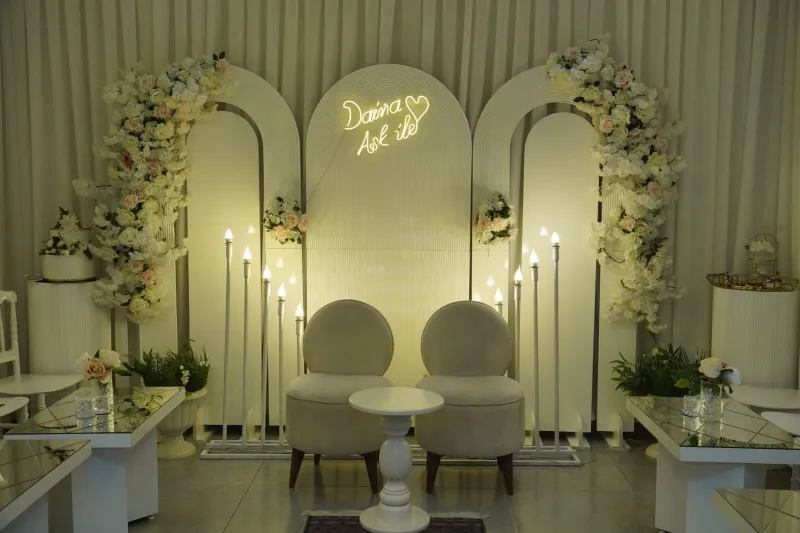
Walk into a high-end wedding in Houston, Dearborn, or Los Angeles right now and there's a decent chance you'll hear the unmistakable stomp of dabke before the DJ ever drops a Top 40 track. You might spot a floral installation that looks like it was lifted straight from a courtyard in old Damascus — cascading jasmine, bougainvillea climbing wooden trellises, lanterns throwing warm amber light across a room full of people who have never set foot in the Arab world but are absolutely enchanted by it.
This is not a coincidence. This is the Arab-American wedding industry doing what it does best: making everyone feel like they stumbled into the most beautiful celebration of their lives.
The Business Behind the Beauty
The American wedding industry generates somewhere north of $70 billion annually, and Arab-American vendors are carving out a slice of that pie that is growing faster than most people realize. Wedding planners, florists, caterers, photographers, and entertainment companies with roots in Lebanon, Egypt, Syria, Jordan, and Palestine are no longer marketing exclusively to Arab diaspora clients. They are pitching — and winning — contracts with couples from every background imaginable.
Take a planner like Rania Aziz, who started her Detroit-based events company a decade ago primarily serving Lebanese-American families in the metro area. Today, roughly 40 percent of her client base is non-Arab. "They come to me because they've been to a friend's wedding and they want that feeling," she told us. "They can't always name it, but they know it when they see it. It's warmth. It's abundance. It's a room that feels genuinely alive."
That intangible quality — the sense that a celebration is not just an event but an experience — is something Arab wedding culture has been perfecting for generations. And American couples are hungry for it.
Flowers That Tell a Story
If there's one visual signature that has migrated most visibly into mainstream American weddings, it's the floral philosophy rooted in Arab aesthetics. This is not your minimalist, single-stem-in-a-bud-vase approach. Arab-influenced floral design operates on a different scale entirely — think towering centerpieces, flower walls so dense they look like living tapestries, and ceremony arches heavy with roses, gardenias, and greenery that would make a Damascene garden jealous.
Floral designers like Nadia Haddad, who runs a studio out of Los Angeles, have built loyal followings on Instagram and TikTok by documenting the sheer scale of their work. Her reels regularly rack up hundreds of thousands of views from brides who have never met an Arab person in their lives but are saving her content to show their own vendors. "Flowers in our culture are not decoration," Haddad explains. "They are hospitality made visible. When you walk into a space and it takes your breath away, that is the host saying: you matter. You are worth this."
That philosophy translates across cultural lines with almost no friction at all.
The Sound of Celebration
Music is where things get really interesting — and a little bit complicated. Arab wedding entertainment has its own ecosystem: live bands playing classic Arabic pop, professional dabke troupes who can get a crowd moving regardless of whether anyone in the room has ever heard the word dabke before, and a new generation of DJs who have mastered the art of blending Fairuz with Frank Ocean without making either feel out of place.
Entertainers like DJ Kareem Nasser, who splits his time between weddings in Chicago and New York, have essentially invented a new genre of celebration music. "My sets are designed so that the grandma from Beirut and the college roommate from Ohio are both on the dance floor at the same time," he says. "That's the whole challenge. That's also the whole joy."
This cross-cultural dancefloor is becoming a genuine selling point. Non-Arab couples who hire Arab entertainment companies often cite the energy of Arab wedding music — its insistence, its communal pull — as something they couldn't find anywhere else. And vendors are smart enough to lean into that.
Food as Love Language
No conversation about Arab weddings is complete without talking about the food, and Arab-American caterers are well aware that their menus are often the detail guests remember most. Mezze spreads that stretch the length of a banquet table. Whole roasted lamb as a centerpiece. Knafeh stations that draw longer lines than the open bar.
Caterers who once worried that American clients might find Arabic cuisine too unfamiliar are now fielding the opposite problem: demand that outpaces their capacity. "People have traveled more, they've watched more food content, they've eaten at Lebanese restaurants," says caterer Sami Barakat, who operates out of New Jersey and now caters as many non-Arab weddings as Arab ones. "They know what hummus is. They want to go deeper. They want the whole table."
The whole table, in Arab wedding culture, is never just food. It is a statement about generosity, about family, about the kind of love that expresses itself through excess in the most beautiful sense of the word.
Why This Moment Is Different
Arab-American creatives have been working in the wedding industry for decades. So what makes this particular moment feel like a tipping point? A few things are converging at once.
Social media has given vendors a platform that bypasses traditional gatekeepers entirely. A florist in Dearborn can reach a bride in Nashville without ever placing an ad. The pandemic-era hunger for celebration — for big, loud, joyful gatherings — aligned perfectly with a cultural tradition that has always understood that weddings should feel like the world is ending in the best possible way. And a broader American curiosity about Arab culture, fed by music, food, and storytelling, has made couples more open to saying yes to something they might not have considered before.
The result is an industry within an industry: Arab-American wedding professionals who are not waiting for mainstream America to discover them but are actively, confidently building businesses that shape what celebration looks like for everyone.
The Bigger Picture
What's happening in the wedding industry is a small but telling window into something larger. Arab-American culture is not sitting quietly on the margins of American life, waiting to be noticed. It is showing up — in the flowers, in the music, in the food, in the very architecture of how Americans mark their most important days — and it is doing so with the kind of confidence that comes from knowing your traditions are worth sharing.
For the couples who hire these vendors, it is often the beginning of a longer curiosity. For the vendors themselves, it is proof that culture is never really niche when it is done with enough heart.
And for anyone who has ever danced at an Arab wedding, surrounded by strangers who somehow feel like family, none of this is surprising at all.