Oud, Amber, and Attitude: Why Arab Perfume Brands Are the New Status Symbol in America
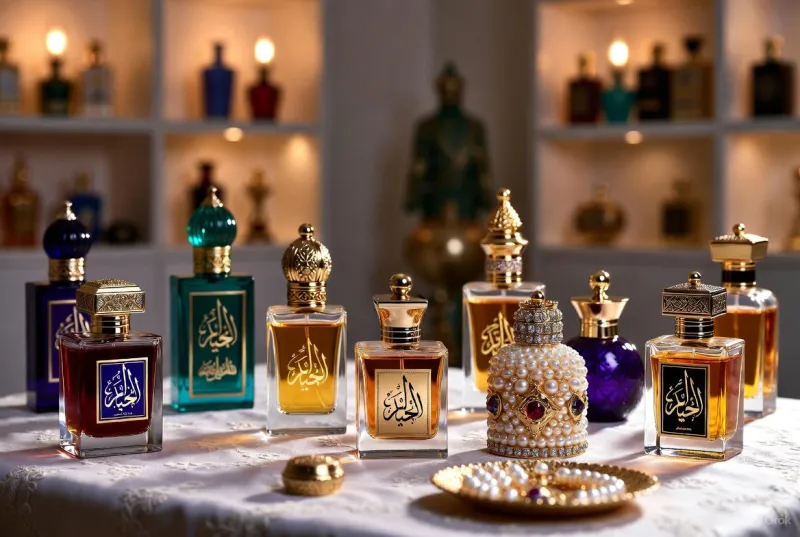
Photo: luxury Middle Eastern oud perfume bottles Arabic fragrance, via mahadiperfumes.com
Walk into any serious fragrance conversation in America right now — the kind happening on Reddit's r/fragrance, on fragrance TikTok, in the pages of beauty publications that used to cover only French and Italian houses — and you'll keep bumping into the same names. Amouage. Bvlgari's oud line. Arabian Oud. Rasasi. Lattafa. Al Haramain. A few years ago, these brands were known primarily within Arab and South Asian communities in the US. Today, they're coveted by collectors, debated by enthusiasts, and stocked in retailers that once would have looked right past them.
Something significant is happening in the American fragrance market, and it smells like oud.
The Scent That Changed Everything
To understand why Arab perfumery is having its moment in the US, you have to understand oud — also called agarwood — and why it's unlike anything the Western fragrance tradition had to offer.
Oud comes from the resinous heartwood of Aquilaria trees, primarily found in Southeast Asia and parts of the Middle East. When the tree becomes infected with a particular mold, it produces a dark, fragrant resin as a defense mechanism. That resin, when distilled, yields one of the most complex and expensive aromatic materials on earth. A single kilogram of high-grade oud oil can cost more than $30,000. It's been prized in the Arab world, South Asia, and East Asia for centuries — used in religious ceremonies, worn as a mark of status, burned in homes as incense.
Western perfumery largely ignored it for most of the twentieth century. Then, sometime in the early 2000s, houses like Tom Ford, Yves Saint Laurent, and Giorgio Armani started incorporating oud into their compositions, marketing it as an exotic, luxurious novelty. American consumers got a whiff — literally — and wanted more. The problem was that the Western interpretations of oud were often softened, sweetened, and stripped of the material's most challenging qualities to make them more palatable to noses that weren't used to it.
Arab fragrance houses, meanwhile, had been doing oud right for generations. Once American consumers started seeking out the real thing, those houses were right there waiting.
Craftsmanship With Centuries of Context
What separates the top Arab perfume houses from the Western brands doing oud as a trend is the depth of cultural and artisanal knowledge behind the product. This isn't a style they adopted — it's a tradition they inherited.
Houses like Amouage, founded in Oman in 1983 with the explicit mission of creating "the gift of kings," or Arabian Oud, which has been operating out of Saudi Arabia since 1982 and now has hundreds of stores worldwide, bring an approach to fragrance that's fundamentally different from the European model. The focus on raw materials is obsessive. Sourcing networks for oud, rose, saffron, and amber stretch across continents. The willingness to let a fragrance be bold, dense, and unapologetically itself — rather than engineered for mass-market accessibility — produces scents that American enthusiasts describe, repeatedly, as unlike anything else they've tried.
That distinctiveness is a selling point, not a liability. In a market saturated with similar-smelling designer fragrances, something that genuinely stands apart has enormous appeal.
Smart Marketing Meets Authentic Storytelling
The rise of Arab fragrance brands in America isn't just about the product — it's about how those brands have learned to communicate their story to a new audience.
Social media has been transformative here. Fragrance content on YouTube and TikTok has exploded in recent years, and Arab perfume brands have benefited enormously from a community of reviewers and enthusiasts who are genuinely passionate about what they're smelling. When a popular fragrance reviewer does a deep dive on a Lattafa or Rasasi release and talks about the history of the ingredients, the cultural context, and the extraordinary value proposition (many Arab fragrance houses offer complexity that rivals $300 Western bottles at a fraction of the price), that content reaches audiences the brands couldn't have accessed through traditional advertising.
Brands like Lattafa have also been savvy about leaning into their identity rather than trying to repackage themselves as pseudo-European luxury. Their packaging is opulent in a distinctly Middle Eastern aesthetic — heavy glass, gold detailing, architectural bottle shapes. It's not trying to look like it came from Paris. It looks like it came from Dubai, and that's increasingly a mark of prestige rather than a marketing challenge.
The Affordable Luxury Angle
Here's a practical dimension of this story that shouldn't be overlooked: a lot of Arab fragrance houses offer genuinely extraordinary value by the standards of the American luxury market.
While a 3.4 oz bottle of a major French designer fragrance can easily run $150 to $200 at Sephora or Nordstrom, comparably complex — and in many enthusiasts' assessments, superior — Arab fragrances are often available for $30 to $80. That pricing reflects different business models and different market strategies, but for American consumers navigating inflation and scrutinizing every luxury purchase, it's a compelling proposition.
The fragrance community has a phrase for this: "blind buys." It refers to purchasing a fragrance without smelling it first, based on reviews and recommendations. Arab fragrance brands have become some of the most recommended blind buys in online communities, because the risk-reward calculation is so favorable. You might spend $40 on something that becomes your new signature scent. That kind of word-of-mouth is invaluable.
More Than a Purchase — A Cultural On-Ramp
There's something worth noting about what happens when an American consumer falls in love with an Arab fragrance. They start asking questions. What is oud, exactly? Where does it come from? What's the history of perfume in Arab culture? Why does this smell so different from everything else I own?
Those questions lead places. They lead to reading, to exploration, to a curiosity about Arab culture that goes beyond the fragrance bottle. Scent is one of the most emotionally direct sensory experiences we have — it bypasses the analytical brain and hits somewhere more instinctive. When that experience is connected to a cultural tradition, it creates a form of appreciation that's genuinely felt rather than intellectually constructed.
For Arab-American communities, watching their cultural heritage become something that mainstream American consumers actively seek out and celebrate is meaningful. And for the fragrance houses driving this shift, the American market is just getting started. The shelves are being stocked. The reviews are being written. The bottles are being opened.
Take a deep breath. Arab perfumery has arrived.