The House Lights Are Up: Arab-American Playwrights Move From Community Stages to the Main Stem
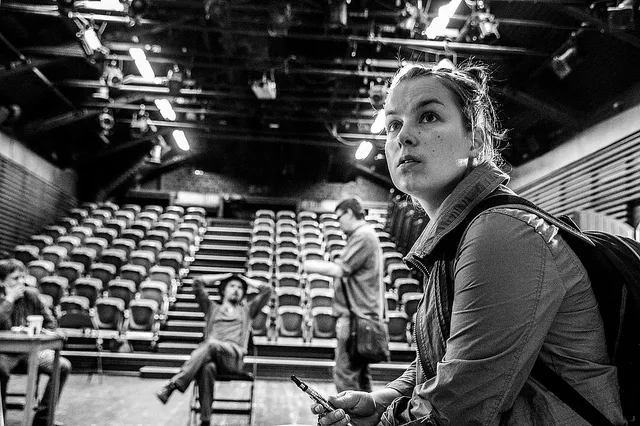
Photo: Rakvereteater, CC BY-SA 3.0, via Wikimedia Commons
On a Friday night in Chicago, the line for a 90-seat theater wraps past a falafel counter and a phone-repair shop. Inside, the set is a kitchen table, a stack of immigration forms, and a screen projecting a Google Maps route from Damascus to Dearborn. The play is sold out. The audience is half Arab-American families, half theater subscribers who saw a review and decided to take a chance. This is how a lot of Arab-American theater begins: in rooms small enough that you can hear the audience breathe.
In 2026, those rooms are getting bigger.
The Pipeline Is No Longer a Secret
For years, the path was predictable. A playwright would mount a reading at a university, then a workshop at an ethnic-specific festival, then maybe a slot in a regional theater's new-play program. Then nothing. The script would go back in a drawer while the writer taught composition or wrote for television. The infrastructure existed, but it was thin.
That is changing. Noor Theatre in New York, Golden Thread Productions in San Francisco, and Silk Road Rising in Chicago have spent years building the talent pipeline that larger houses now draw from. Regional theaters in Minneapolis, Portland, Boston, and Washington, D.C., have started commissioning Arab-American writers not as a diversity box to check but because the scripts are good and the audiences are there. The work is moving from the community center to the main stem — not all at once, but steadily.
The names are no longer obscure to theater people. Heather Raffo's Nine Parts of Desire turned Iraqi women's testimonies into a one-woman landmark. Mona Mansour's The Vagrant Trilogy followed a Palestinian family across decades and borders. Yussef El Guindi has spent years writing sharp, funny plays about Arab men navigating American expectations. Denmo Ibrahim's work has moved between solo performance and ensemble pieces. These writers are not new. What is new is the appetite for their work beyond the festival circuit.
Paperwork as Dramaturgy
A lot of the new work shares a preoccupation: the document. Visa petitions. Green card interviews. Asylum affidavits. Rental applications. The plays are not all about trauma, but they are often about the paperwork that surrounds it. A scene will hinge on a checkbox. A monologue will be built from the questions on a USCIS form. The drama is not just in what happened back home. It is in what the American system asks you to prove about it.
That is one reason theater may be the next frontier after film and streaming. Film can show a border crossing. Theater can stage the waiting room. It can put the audience in the same fluorescent light as the person holding a number. It can make the bureaucratic language feel like a character.
Post-9/11 memory runs through this work, too. The writers who came of age after 2001 grew up watching their families explain themselves — at airports, in schools, on cable news. Now they are writing plays that refuse to explain. The characters are not ambassadors for a religion or a region. They are petty, funny, tired, horny, and specific. That specificity is what makes the plays travel.
Why Theater, Why Now
Theater is cheaper than a pilot and faster than a development slate. A playwright can write a two-hander in a year and see it staged in a 120-seat house with a budget smaller than a single day of a streaming shoot. That speed matters. It lets Arab-American writers respond to the news cycle without waiting for a green light from a studio.
Theater also offers something streaming cannot: a live room. When an audience laughs at a joke about an aunt's interrogation of a fiancé, the laugh is shared. When a monologue about a demolished building lands in silence, the silence is shared. For stories that have often been mediated by news footage, that liveness is powerful.
The Mixed-Audience Test
The new challenge is writing for two audiences at once. How do you write for an Arab aunt who has lived the story and a theater subscriber who has never left Ohio? The best playwrights refuse to choose. They write for the aunt, and they trust the subscriber to keep up. Footnotes are replaced by context. Arabic phrases are left untranslated when the meaning is clear from the scene. The result is not a lecture. It is a conversation.
That conversation can be uncomfortable. Some plays ask Arab-American audiences to sit with internal conflict — colorism, classism, the way families police their own. Other plays ask white subscribers to sit with their own assumptions. A successful production does both without turning the stage into a panel discussion.
What Comes Next
The next step is not a Broadway musical about hummus. It is infrastructure. Directors. Designers. Literary managers. Producers who know how to market a play with an Arabic title without exoticizing it. The writers are there. The audiences are there. What is still missing is the middle layer — the people who can move a script from a 99-seat house to a 500-seat house without losing its nerve.
In 2026, that middle layer is forming. The house lights are up. The line is around the block. The play is about to start.