Za'atar on the White Tablecloth: How Arab Chefs Are Crashing America's Fine Dining Scene
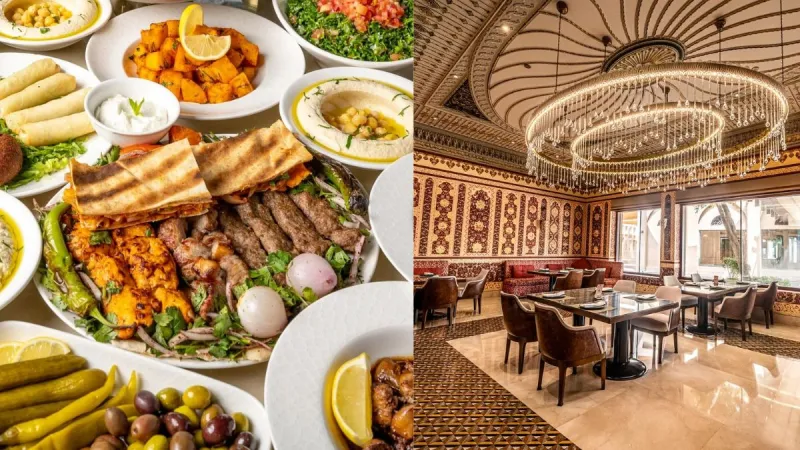
Photo: elegant Middle Eastern restaurant fine dining plating Arabic cuisine, via curlytales.com
There's a moment that happens in a lot of high-end Arab restaurants across the US right now. A server sets down a small plate — maybe a smear of whipped labneh dotted with Aleppo pepper oil, or a single lamb chop resting on a pool of pomegranate molasses reduction — and the table goes quiet. Not the polite, awkward quiet of people unsure what they ordered. The good kind. The oh, I didn't know food could do that kind.
That moment is happening more and more, from Dearborn to Downtown Manhattan, and it's no accident. A generation of Arab-American chefs and restaurateurs has decided, collectively and loudly, that their grandmothers' recipes deserve the same reverence as French technique and the same Instagram real estate as omakase counters.
Not Your Neighborhood Hummus Joint
Let's be clear about something: there's nothing wrong with the neighborhood shawarma spot. Those places are beloved institutions, and they'll stay that way. But the conversation around Arab food in America has, for too long, been stuck at the level of "affordable and filling" — a perception that Arab chefs working in fine dining are actively, and deliciously, dismantling.
Chefs like Rawia Bishara of Tanoreen in Brooklyn — widely considered a godmother of elevated Arab cuisine in New York — spent years proving that Palestinian home cooking could hold its own in a city drowning in Michelin-starred competition. Her lamb ouzi, slow-roasted with caramelized onions and toasted nuts, reads like a love letter to Nazareth written in a New York accent. She didn't simplify the dish for American palates. She trusted the dish.
That trust — in the food, in the diner, in the culture — is the defining attitude of this new wave.
The Beirut Blueprint
If there's a city that functions as the spiritual headquarters of this culinary movement, it's Beirut. Long before the fine dining boom hit Arab-American communities stateside, Beirut was already running one of the most sophisticated restaurant cultures in the world. Chefs who trained there — or who grew up eating there before immigrating — brought that cosmopolitan sensibility with them.
That influence shows up in how these restaurants are designed and operated. We're talking curated wine lists featuring Lebanese producers from the Bekaa Valley, tasting menus that move through regions the way a road trip moves through landscapes, and front-of-house teams trained to narrate the cultural story behind every dish. This isn't fusion for fusion's sake. It's hospitality as cultural transmission.
Restaurants like Beit in Chicago and Mamnoon in Seattle have built entire identities around this approach — spaces where you come to eat and to understand something. Where the menu is essentially a guided tour of the Levant, the Gulf, or the Maghreb, depending on whose kitchen you're sitting in.
Rewriting the Perception Problem
Here's the honest part: Arab food has had a perception problem in the US for a long time. Decades of media that reduced the Middle East to conflict zones didn't exactly prime American diners to think of the region as a source of culinary sophistication. Arab restaurateurs have been quietly fighting that narrative one plate at a time.
"People walk in expecting falafel and pita," one New York-based Lebanese chef told us, laughing. "They walk out having had a five-course tasting menu with a natural wine pairing and a dessert built around orange blossom and aged goat cheese. Their whole framework shifts."
That framework shift is exactly the point. When a dish gets plated with intention, when the lighting is right and the story is told properly, diners don't just taste the food — they reconsider everything they thought they knew about the culture it came from. That's a powerful thing. Arguably more powerful than any op-ed.
The Michelin Question
The elephant in the room, of course, is the Michelin Guide. Arab restaurants in the US have been edging closer to that recognition, with several receiving Bib Gourmand distinctions — Michelin's nod to exceptional value — but the starred ranks have remained elusive for most. That's starting to change.
The conversation in culinary circles is increasingly acknowledging that Michelin's traditional Eurocentric framework has undervalued non-Western fine dining traditions. As that bias gets called out and the guide expands its cultural vocabulary, Arab cuisine is positioned to benefit enormously. The food is already there. The technique is already there. The question was always whether the gatekeepers were paying attention.
They're paying attention now.
Community as the Secret Ingredient
What separates the most successful Arab fine dining spots from just being expensive Middle Eastern restaurants is something harder to quantify: community. These places function as cultural anchors. You'll find Arab-American professionals celebrating promotions there, diaspora families marking milestones, and curious non-Arab diners who keep coming back because they feel something in the room that goes beyond the food.
Many of these chefs are deeply intentional about that. They hire within their communities, source from Arab-owned farms and importers where possible, and host events — poetry readings, live oud performances, Ramadan iftars — that make the restaurant feel like a living, breathing cultural space rather than just a place to eat.
That's the Beirut blueprint playing out in Brooklyn, in Houston, in Dearborn. Food as identity. Hospitality as resistance. The white tablecloth as a statement.
What's Next on the Menu
The momentum isn't slowing down. A new crop of Arab-American culinary school graduates is entering the industry with both classical training and fierce cultural pride — a combination that's producing some genuinely exciting results. Gulf cuisine, long overshadowed by Levantine dishes in the American consciousness, is starting to get its moment, with chefs exploring the spice routes and pearl-diving traditions of the Arabian Peninsula through contemporary plating.
Moroccan and Tunisian flavors are also getting a second look, moving beyond the tagine-and-couscous shorthand into more nuanced territory. And Egyptian street food — koshari, hawawshi, ful medames — is quietly building a case for its own elevation.
The Arab table has always been one of the world's great culinary traditions. It just took a generation of bold, culturally grounded chefs to make sure America finally got a proper seat at it.